
The seventh Newcastle Climate Change Forum, held at the Civic Centre on 10 November 2026, was the first in the series to give waste an evening of its own. Councillor James Coles (Cabinet Member for Sustainable Housing and Green Investment) and David Trousdale (Principal Advisor, Climate Change and Net Zero) introduced the evening, and the main presentation came from Rebecca Wilson, Operations Manager in Waste and Recycling at Newcastle City Council. Rebecca shared details of the food waste roll-out, the reasons behind it, and the results the council intends it to deliver, before the room broke into table discussions with points shared back at the close.
The Roll-Out
The citywide service follows the trial launched in September 2024, which began with around 5,200 households across six wards: Kingston Park South, Newbiggin Hall, Blakelaw, West Fenham, Benwell and Scotswood, and Wingrove, extended by a further 500 households in January 2026. The pilot has now collected around 600 tonnes of household food waste. The full roll-out to every household follows the government’s requirement, under the Environment Act 2021, for separate weekly food waste collections across England; the council, like many authorities, missed the 31 March 2026 deadline, with the collection vehicles still in procurement, and expects to begin the full service later in 2026. Once extended citywide, the council expects to collect between 6,000 and 7,000 tonnes a year, enough to power 1,000 homes.
The Reasons Behind It
Food waste makes up around a third of the average household bin. When it rots in landfill it releases methane, a greenhouse gas far more potent than carbon dioxide, which is why separating it is one of the simplest climate measures a city can take. The service also gives residents cleaner bins and a weekly collection, and it raises the city’s recycling rate at a time when Newcastle’s net zero commitments are justifiably under scrutiny.
The Intended Results
The collected waste goes to the biogas facility at Wardley, Gateshead, where anaerobic digestion transforms it into biogas used in Combined Heat and Power engines to generate renewable electricity and heat. The pilot’s 600 tonnes have generated enough renewable energy to power 563 homes, along with around 400 tonnes of nutrient-rich liquid fertiliser for local farms. The council also notes the biogas can be upgraded to National Grid standards as renewable gas, an option that may matter as the service scales.
The Wagons, and the Arithmetic Behind the Picture
The food waste round runs on small, sealed collection vehicles, similar in size to the caged wagons used for fly-tipped waste, rather than the large refuse lorries. A full wagon carries roughly 2.5 to 3 tonnes of food waste, which at Wardley becomes around 275 to 330 cubic metres of biogas, holding about 1,650 to 2,000 kilowatt-hours of energy.
That is where the numbers become worth saying aloud. A typical Newcastle home uses around 10,600 kilowatt-hours of gas in a year, roughly 880 kilowatt-hours in an average month and about 1,270 in a January. One full wagon-load of the city’s peelings and leftovers therefore holds enough energy to heat a home for about two months, and it covers more than a month of a Newcastle January. Against fossil gas, each load saves roughly a third of a tonne of carbon dioxide, and by never reaching landfill it keeps several tonnes more out of the sky.
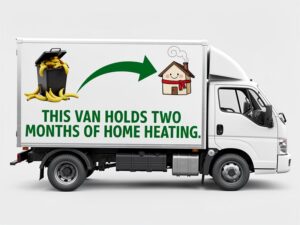
The picture below is a mock-up of what that could look like on the side of the collection vehicles: a black kitchen caddy of banana skins, a home in a scarf, and the line the arithmetic earns.
This van holds two months of home heating.
The design is offered to the council’s Waste and Recycling Engagement Team as public messaging for the roll-out: the numbers are verified, the caddy is the one residents know from their own counter, and the promise is one a resident can check against their own gas use.
Table Discussions
The presentation was followed by table discussions with a Council Officer on each. These discussion points were shared back with the room. It is hoped these notes will be publicly shared.
Looking Ahead
With the citywide roll-out due in the new year and the national deadline behind it, the evening’s quiet conclusion was that Newcastle’s food waste service has moved from experiment to infrastructure. The remaining task is the human one: making the numbers known, so that the weekly scrape of the caddy is understood for what it is, the city’s own energy, gathered from its own kitchens and returned as light, heat and fertiliser.